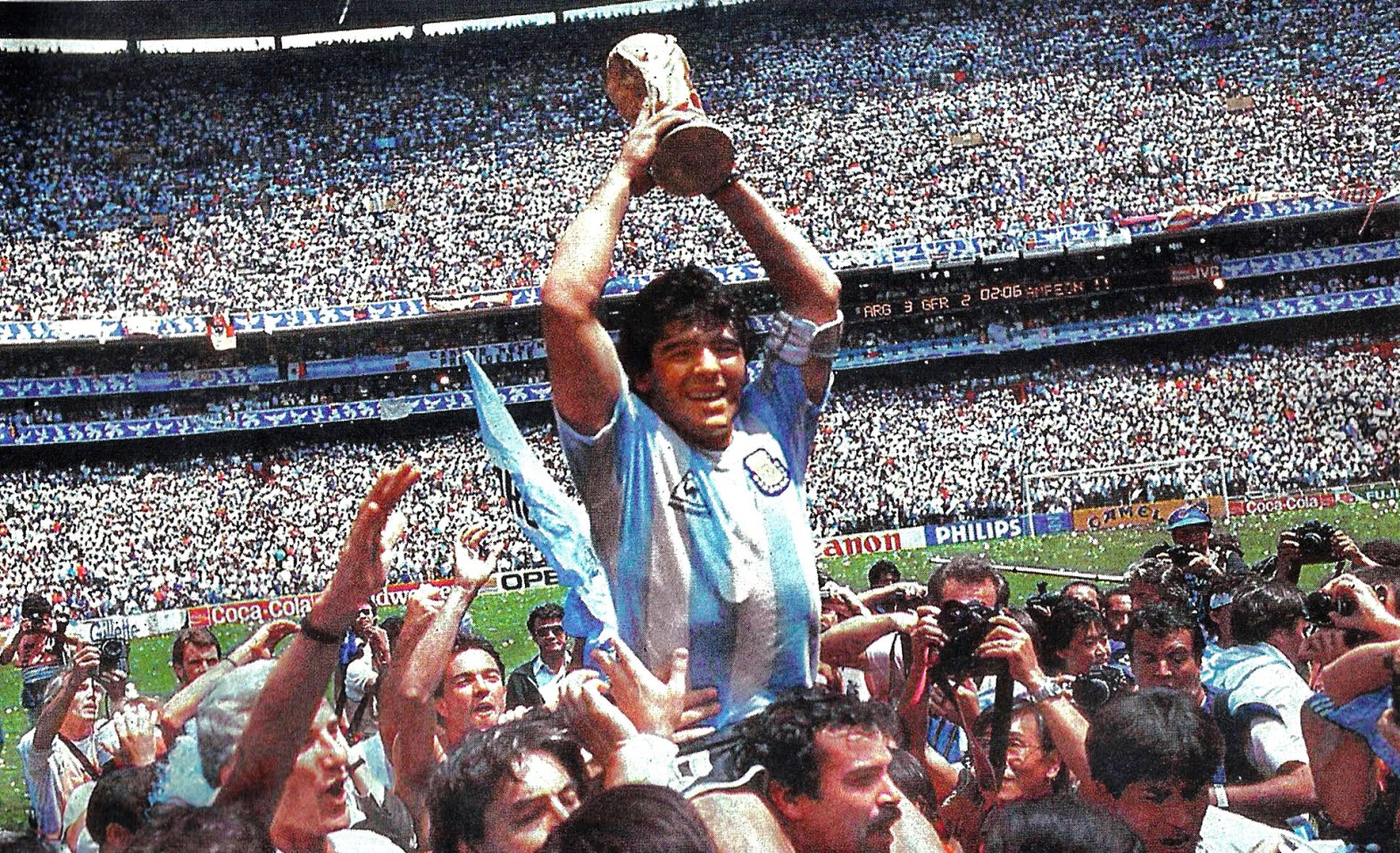
The second of four articles that form my tribute to the unique flawed genius, the late and great Diego Maradona.
In the first part of this article, I introduced who Diego was, and explained his impact on fans and the history of the game. In this second part, I will delve into the early part of his career, and examine what made him such an adored figure, despite his flaws.
It can be difficult to empathise with Maradona and reconcile with his controversial behaviour when he seemingly had everything and essentially threw it away. To understand what Diego had gone through in his life, however, which might explain his actions to an extent, it is important to take into consideration where he came from. If one searches for Maradona’s childhood home on Google, the following image comes up:

The Makings of a Star
Diego was born on 30 October 1960 in Lanús, to a father who was of Guaraní Indigenous descent, and a mother of European (predominantly Italian) descent. He grew up in violent poverty in Villa Fiorito, a villa miseria on the outskirts of Buenos Aires. As a minority from a poor background, he therefore clearly did not enjoy the privileges that many of us take for granted, which certainly makes him more sympathetic, and one can certainly empathise with him and understand his struggles, while simultaneously not condoning his later more contentious actions. As Wright Thomson notes in “Here and Gone” a brilliantly insightful 2012 article for ESPN, when comparing the childhood of Maradona to that of Messi, “[Maradona’s] entire life was a fight to escape the facts of his own birth, and when he succeeds, and even when he fails, his countrymen recognize his struggle. They understand the wellspring of his talent and his demons. Everything Maradona has ever done can be explained by the rough streets of Fiorito.” All he had was football, and an incredible talent, which was his only way out of a life of extreme poverty.
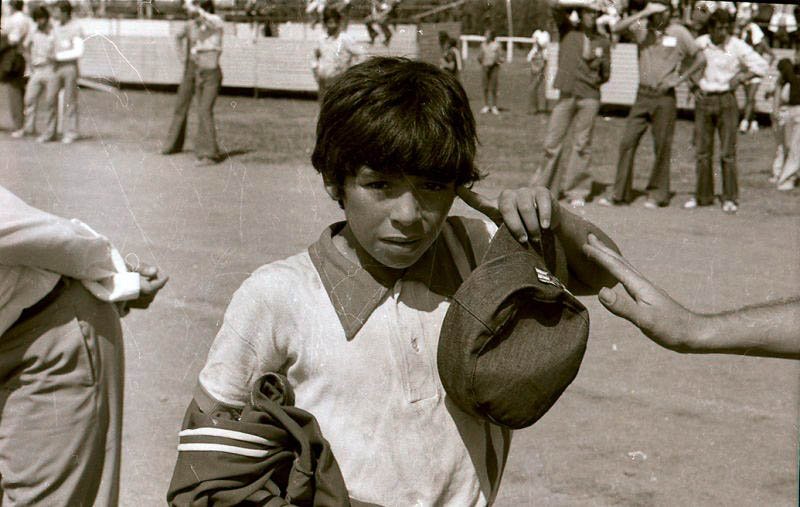
After making a name for himself with his impressive ball-juggling skills as a ball-boy, having already caught the attention of scouts at an early age while playing in the streets, he became a professional footballer at the age of 15 on 20 October 1976 with Argentinos Juniors, becoming the youngest player ever to debut in the Primera División Argentina at the time; the precocious youngster was immediately touted as a promising star, famously nutmegging an opponent on his debut, and soon earning his iconic nickname El Pibe de Oro (“The Golden Kid,” in Spanish). From that moment onwards, he was denied the normal life of a teenager; he soon went on to win the FIFA World Youth Championship with Argentina in 1979, being named as the standout player of the competition, and was named South American Footballer of the Year in 1979 and 1980 by newspaper El Mundo (the South American equivalent of the European Footballer of the Year Award or Ballon d’Or assigned by France Football magazine) for his prolific performances. He subsequently won the Primera División Metropolitano league title in his only season with Boca Juniors in 1981.
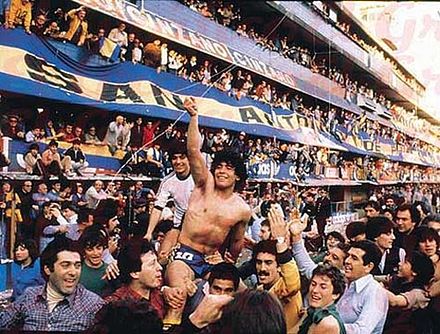
Diego also demonstrated flashes of brilliance and alluded to his potential at the World Cup in Spain later that year, netting twice in a first round victory against Hungary; overall it was a rather mixed showing for Maradona and the defending champions, however, which ultimately ended with a disappointing second round exit in the so-called “group of death,” made up of a stellar Brazil side and the eventual champions, Italy. In Argentina’s match against the latter nation, which ended in a 2–1 defeat, Diego suffered a record number of fouls in a single World Cup match (23), being continually hounded by the aggressive and overly physical marking of the notorious Italian stopper Claudio Gentile; regarding his performance, the defender later infamously remarked (in a rather politically incorrect manner by today’s standards): “football is not for ballerinas.” The young and inexperienced Maradona also showed his immaturity and lack of discipline, however, as he was sent off in a 3–1 loss against rivals Brazil for an aggressive retaliatory foul, kicking João Batista da Silva after the latter’s challenge had knocked Juan Barbas to the ground. Nevertheless, his promising displays with Boca and Argentina earned him a then world record transfer fee to Spanish giants Barcelona later that year. The story of his success against all odds is therefore quite incredible. However, it seems unfair that he was not prepared to deal with both the positive and the negative aspects of fame and fortune; regrettably, this tale has become all too common in football.
Mixed Fortunes in Spain

Maradona’s first season in Spain was generally positive, and saw him score over 20 goals in all competitions and win multiple titles, including the Copa del Rey and the Copa de la Liga over rivals Real Madrid, scoring a stunning individual goal in the first leg of the latter final at the Santiago Bernabéu stadium: after sprinting onto a teammate’s pass, he rounded the keeper Agustín in a one on one situation, and coolly evaded the sliding challenge of the hapless Juan José, who crashed into the post, before slotting the ball home with a composed left-footed finish. His performance during the match led him to become one of only a handful of Barcelona players ever to be given a standing ovation by the opposing Real Madrid fans in the Spanish capital.
While he maintained a respectable goalscoring record the following year, also winning the Supercopa de España, his second season with Barcelona was far less impressive, however, in part due to a serious injury he sustained, as well as Diego’s problematic behaviour on the pitch, which led him to fall out of favour with the club. This included his involvement in a violent brawl in the 1984 Copa del Rey Final against Athletic Bilbao, which later became known as the Battle of Bernabeu, during which he kneed Miguel Sola in the head, knocking him out. As a result of his aggressions, Maradona received a four–month ban, and would not play for the club again. Once again, however the context surrounding the match should be taken into consideration. In the previous encounter between the two clubs in September 1983, Andoni Goikoetxea had harassed Maradona all game with harsh tackles, including one from behind that left him with a serious, potentially career–ending injury, which sidelined him for an extensive period, during which he contracted hepatitis; the incident saw Goikoetxea banned for 18 games (later reduced to 10 on appeal), and earned him the nickname “The Butcher of Bilbao.” Although Maradona’s violent conduct in the final was certainly shocking, to say the least, it should be noted however that he had dealt with taunts and insults from the opposing manager and players both in the lead-up to and during the match, and, even more seriously, with xenophobic and racist insults from the fans; moreover, he claimed to have been targeted by the opposing players’ challenges throughout. Nevertheless, the infamous match would be his last for Barcelona.

Becoming the King of Naples
“I want to become the idol of the poor kids of Naples, because they are just like how I was in Buenos Aires.”
Diego Maradona on the day he was presented to Napoli, 5 July 1984
Later that year, Maradona was sold to Napoli for $13 million, once again breaking the world record transfer fee. It was here that Diego truly cemented his status in the annals of football. His move to Napoli was certainly surprising; the club had narrowly avoided relegation the previous season by a single point, finishing in 11th place in the league (out of 16 teams) in 1983–84. Serie A was the strongest league in the world at the time, with seven Italian clubs – known as the “seven sisters” – regularly competing for the league title, such as Sacchi’s legendary Milan side that won back-to-back European Cups in 1989 and 1990, which is considered to be one of the greatest teams of all-time. It was a league in which all of the best players across the globe starred, such as Zico, and later Ruud Gullit, Marco Van Basten, Lothar Matthäus, and Roberto Baggio, as well as three–time Ballon d’Or winner, French playmaker Michel Platini, who had conquered both Italy and Europe with Juventus under manager Giovanni Trapattoni. Being a more tactical and defensive–minded league, teams were often very closed and difficult to break down. Indeed, Serie A was a league in which the zona mista (or gioco all’Italiana – game in the Italian manner), system prevailed, combining aspects of both Italian catenaccio inspired “man-to-man marking” and zonal defence popularised by Dutch total football under Rinus Michels. As a result, in Italian football, spaces were scarce, matches were often tightly fought, and score-lines were often very low. Serie A also featured some of the most formidable defenders and goalkeepers of their era, including the almost unsurmountable Milan back-line of Paolo Maldini, Franco Baresi, Alessandro Costacurta/Filippo Galli, and Mauro Tassotti. Because of this, many talented players, such as Michael Laudrup, even struggled in Italy. This was not the case with Maradona, however, and certainly a player of his talent would have attracted the attention of larger clubs, despite his reputation as a problematic player. Prior to his arrival, aside from some minor European titles in Napoli’s trophy cabinet (namely the 1966 Coppa delle Alpi and the 1976 Anglo–Italian League Cup), the Neapolitan club had only ever won two major trophies in its history, claiming the Coppa Italia twice, with their last success in the domestic cup dating back to 1976 (and it also must be said that in Italy, in contrast to the FA Cup in England, the Coppa Italia unfortunately also lacked prestige). Moreover, no team south of Rome had ever won the league title. All of that was about to change, however. Maradona’s impact on both the city and the club was significant; it was there that he played the best football of his career, and completely dominated the best league in the world. His crowning achievement, however, came on the biggest stage, namely at the 1986 World Cup in Mexico.

A Legend who Conquered the World
Much has been written about Maradona’s performance throughout the 1986 World Cup. Unfortunately I was not able to witness it, and rewatching his matches now, regardless of how impressive they look, does not seem to do them justice. Many pundits almost unanimously agree, however, that it was “one of the greatest individual performances in tournament history,” as Kevin Baxter of the Los Angeles Times described it in 2014, with Roger Bennet of ESPN FC instead dubbing it “the most virtuoso performance a World Cup has ever witnessed.”
To bring in some statistics in order to give a more objective demonstration of Maradona’s influence on Argentina’s victory, throughout the tournament, he:
- Either scored or assisted ten of Argentina’s 14 goals (five goals and five assists), being directly involved in 71% of his team’s goals throughout the tournament; among World Cup winners, only David Villa of Spain had a superior ratio in 2010, being involved in 75% of his team’s eight goals (five goals and one assist)
- According to Opta statistics, Maradona’s combined ten goals and assists in 1986 are the highest number of direct goal involvements ever by a player at a single World Cup since 1966, and he is currently also the only player both to score and create five goals in a single edition of the tournament.
- He provided the most assists, with five
- He created more chances (27) than any other player
- He either scored or assisted a goal in every match, except for the 1–0 round of 16 victory over Uruguay, during which he still had a hand in the lead-up to the decisive goal.
- He claimed the Silver Boot award with five goals; only England striker Gary Lineker scored more goals (6), winning the Golden Boot award
- He took or created 57 of Argentina’s 101 shots throughout their seven matches at the World Cup (27 chances created and 30 shots)
- He completed more dribbles (53) than any other player in the tournament; his tally in the tournament is still a record for a single edition of the World Cup
Additionally, according to James Darby of Goal.com:
“[Maradona] attempted or created 52% of all Argentina’s shots during the finals and embarked on 90 dribbles, more than three times as many as any other player. He was also fouled 53 times, winning almost twice as many free kicks as any other player.”
James Darby of Goal.com
But it was not just the statistical influence of his play which was astounding, it was also the beauty and audacity of the goals he scored, as demonstrated by his clever dummy and cheeky half-volley in Argentina’s 1–1 first-round draw against defending champions Italy.
“No other player, not even Pel[é] in 1958 nor Paolo Rossi in 1982, had dominated a single competition the way Maradona did in Mexico. […] The brilliant Argentine artist single-handedly delivered his country its second World Cup.”
John Molinaro, CBC Sports, 2009
However, it was one game, that truly stands out above the rest, and which epitomises what exactly made Maradona so loved but equally despised. In the quarter-finals, Argentina faced England, one of the strongest teams in the world at the time; the Falklands War between the two nations had only occurred four years earlier, and a tense underlying atmosphere evidently surrounded the lead-up to the match (the political context surrounding the history of these territories and the relationship between the two nations is complicated; after obtaining independence from Spain in 1816, Argentina claimed ownership of the Falklands in 1820; in 1833, however, British forces removed the Argentines and occupied the islands, and they eventually earned colonial status in 1892. In 1981, islanders voted to remain British in a referendum; with diplomatic efforts to seize control of the territories failing, the Argentine military junta therefore invaded the Falklands the following year, in an effort to promote patriotic sentiment in Argentina following criticism of the regime throughout the country).
In the ensuing fixture between the two national sides at the Azteca Stadium, in the Mexican capital, Maradona scored two of the most famous goals of his career. The first was marred by controversy. After undertaking a solo run and playing the ball to a teammate, Maradona attempted to latch onto a mishit clearance inside the opposing penalty area; realising that he would not be able to beat the on-rushing and much larger goalkeeper Peter Shilton to the ball, the diminutive Maradona shockingly punched the ball into the goal, disguising the gesture with a synchronised flick of his head, and subsequently ran to the corner flag, encouraging his baffled teammates to join him in his celebration. He would later describe this goal as being scored “a little with the head of Maradona and a little with the hand of God.” Ever since, the goal has been known by this name.
Naturally the English players and fans were furious that a goal like that stood, and Maradona himself always seemed to downplay the dishonesty of his gesture, defending it as a cunning play, something for which Shilton never forgave him. Rather astonishingly, to Maradona this goal was also a matter of “revenge” for the Falklands War, as he noted in his 2000 autobiography “Yo Soy el Diego,” commenting:
“We blamed the English players for everything that happened, for all the suffering of the Argentine people […] Before the match we said football had nothing to do with the Malvinas war. But we knew a lot of Argentine kids died, shot down like little birds.”
In hindsight, to exemplify the seemingly endless debate surrounding Maradona, this goal has been described both as a deceitful gesture by his detractors and as an incredible stroke of genius by his supporters. Although it certainly was highly unsportsmanlike of him to score in this fashion, it is undeniably true that Maradona somehow managed to instil a degree of his innate brilliance into such a contentious goal, in a manner in which only he was capable.

“goal of the Century” in the 1986 World Cup quarter-final victory over England
Regardless of one’s personal opinions on the first goal, the validity of the second goal could not be disputed. Receiving the ball just inside his own half on the right side of the pitch, Maradona scored one of the most incredible goals in the history of the sport, which came to known as the “Goal of the Century.”
After turning brilliantly in between two English players with a trademark roulette, he accelerated forward into the space he had created, tearing into England’s half and beating three more defenders on the run, before dashing into the penalty area, rounding the keeper, and finally slotting the ball into an empty net with his left foot from a tight angle. His jubilant celebration and ecstatic run towards the corner flag, coupled with a triumphant leap with a clenched fist towards the heavens, expressed the emotions of all of Argentina at that very moment; his humble origins, the struggles and sacrifices he went through to succeed, and his eventual triumph encompassed everything it meant to be Argentine. Even the commentator Víctor Morales could not suppress his emotion, and was brought to tears by the beauty of this goal. The astounding superlative quality he demonstrated in this act of individual brilliance leads us to wonder whether the validity of the first goal even mattered, seeing the ease with which Maradona obliterated the entire England team; it would almost seem natural to believe that he could have comfortably done so again had he so desired. England managed to grab a consolation goal, but it was of no consequence. Maradona was the undisputed star of the victory, for both positive and negative reasons.
“Maradona, turns like a little eel and comes away from trouble, little squat man… comes inside Butcher and leaves him for dead, outside Fenwick and leaves him for dead, and puts the ball away… and that is why Maradona is the greatest player in the world.”
The iconic commentary on Maradona’s second goal against England in the 1986 World Cup quarter-final by Bryon Butler of BBC Radio
To sum up Maradona’s second goal against England, in 2002, Russell Thomas of The Guardian described it as “arguably the greatest individual goal ever.” In a 2009 article for CBC Sports John Molinaro described it as “the greatest ever scored in the tournament – and, maybe, in soccer.” In a 2018 article for Sportsnet, he added: “It transcended mere sports – his goal was pure art.” It is difficult to argue with them. The goal was later completely immortalised when a commemorative statue of it was erected outside the Azteca Stadium.

Maradona followed up this incredible performance with another virtuoso display, scoring two more goals in the semi-final victory over Belgium; for his second goal of the match, he engaged on another spectacular solo run past several players, before slotting the ball past the keeper with a neat trivela finish with his stronger left foot.
In the closely contested final against West Germany, his influence was less evident in part due to the tight marking of Lothar Matthäus, but nevertheless, he still left his mark as he went on to assist Jorge Burrachaga’s late match-winning goal, with Argentina prevailing 3–2. As his team’s captain, he went on to lift the World Cup trophy, also winning the Golden Ball, as the undisputed best player of the competition.
After all the criticism he faced, Diego had finally proven himself to world, and secured himself a place among the pantheon of greats. It seemed like things could only go up from there, and initially they did. Unfortunately, this was not to be the case for the long, however. The next four years would bring Diego even more glory, but also many more problems…
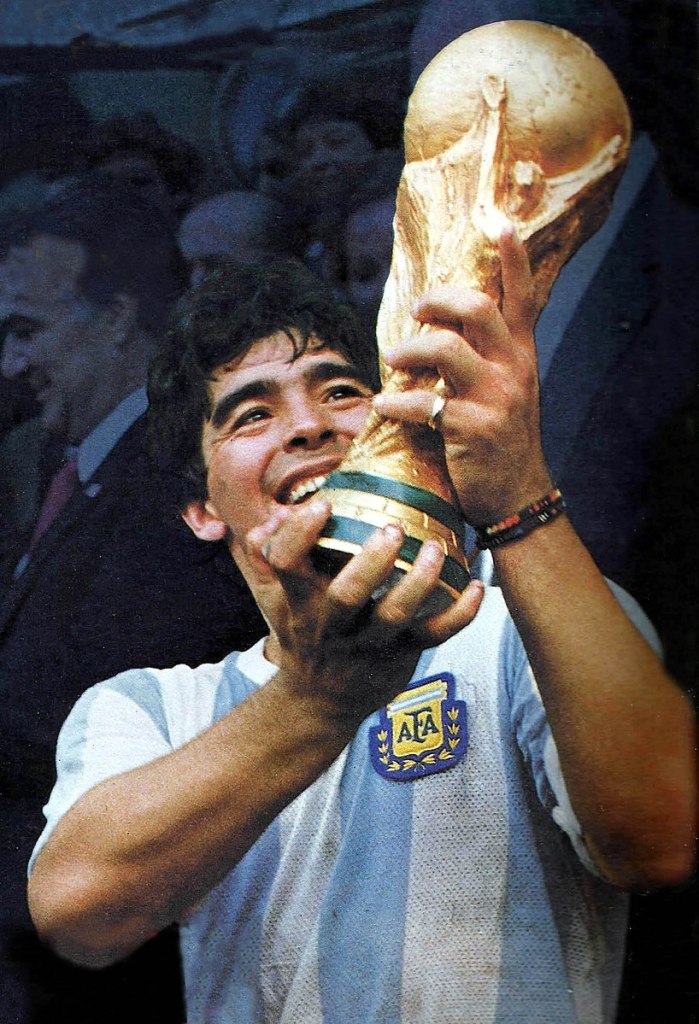
Stay tuned for part 3, the second–last section of this article, which will explore his career with Napoli and the possible reasons for his cult–status among the club’s supporters.
 Mad About Football
One thought on “[Non] Ho Visto Maradona, Part 2: The Rise to Stardom”