
The last of four articles that form my tribute to the unique flawed genius, the late and great Diego Maradona.
The final part of this series on Maradona attempts to decipher what exactly led to his downfall when he was so successful and popular during his time in Naples.
The Perils of Fortune and Fame…
One of the most horrific aspects of a corrupt game such as football is how players have always been expendable; not to be hyperbolic, but to paraphrase Eric Cantona’s famous 2019 speech and quotation of King Lear upon receiving the UEFA President’s Award, they are essentially treated like machines. Their bodies are pushed to the limits, and once they are no longer marketable or can bring in significant revenue, they are discarded and forgotten. And we must admit as fans that we are complicit in this ourselves. If a player has a bad game, we are swift to criticise them as being incapable of handling the pressure needed to be a superstar, or even accuse them of being lackadaisical. We never stop and think about whether they are in good mental health, or might be struggling through physical pain, sickness, or other personal problems. We feel that given their wealth, fame, and the opportunities they have had to pursue a career they love, they should be able to put any struggles aside and be at their best on a weekly basis.
While many players are indeed fortunate for these same reasons, and do get a lot from football, we also need to start treating players better, and like actual people. Many of them come from a disadvantaged background, and have not had the opportunity to pursue extensive education. We often deride them for this, and criticise them for their ignorance, and yet, paradoxically, we also care about what they have to say about broader issues, and equally criticise them for lacking character if they are not particularly loquacious. But if they do venture into other domains, then we accuse them of not putting their whole being into their sport on a daily basis. We expect them to be role models for everyone, and to not make mistakes, when all they really have been taught to do is play football. There is no winning for them. The truth is, players are flawed human beings, like everyone else, who will make mistakes; it can therefore be dangerous to make heroes out of them, or anyone, for that matter. They are not gods, as we often make them out to be, and they certainly have their defects, like all of us, and while they do certainly reap the many rewards from a seemingly dream career, we also must remember that many of them have sacrificed so much to get where they are. This does not excuse any condemnable behaviour, which should always be criticised, but it is more a questioning of the system more broadly and how young players are recruited and developed. They often were not allowed to have the same carefree attitude or make the same mistakes that kids are supposed to make as they grow and learn; a mistake for them could mean being axed from a team, which could cost them their career. While their friends were going out and having fun, they often had to train, watch their diet, avoid injuries, and maintain a strict sleep schedule from an early age; sometimes they even had to leave their families and friends to live and play in other places, with no guarantee that they would actually succeed in fulfilling their dreams. Things have improved to some extent today, but once again, it is very much dependent on a player’s social background.
The Bigger They Come, The Harder They Fall…
Maradona was a victim of this aforementioned ruthless culture surrounding football himself, in particular during his time in Naples. Despite being very attached to his family, he did not have many other people around him guiding him, or attempting to help him through his struggles and work through his defects, or prepare him for life after football, or how to cope with the constant temptations, pressure, and media scrutiny he would face as a star. The aforementioned infamous drug scandal was essentially the final straw in Maradona’s already precarious personal life. News of Diego’s cocaine addiction, his involvement with prostitutes, and his connection to the Camorra, as well as allegations of tax evasion made against him by the Italian tax authorities, broke out mid-way through the 1990–91 season, with the drug charges eventually culminating in his 15-month ban from football in 1991; the consequences were devastating for both his career and his life off the pitch. He essentially became a fallen angel, a shadow of his former self, cast out of the kingdom of heaven he had built himself, and almost forgotten. Although he only retired in 1997 after three seasons back at Boca, his career had precipitated on a downward spiral since his ban, from which he never recovered. After leaving Napoli in 1991, he was arrested for drug possession in Buenos Aires later that year. Following a lengthy period of inactivity and unfortunate struggles with obesity, which hindered his gameplay, he attempted a comeback, but had unsuccessful spells with Sevilla in Spain and Newell’s Old Boys back in Argentina.
Although he eventually noticeably slimmed down and showed glimpses of his former class upon his return to the international stage at the first round of the 1994 World Cup, he never came back from the set-back he suffered following his 1991 ban. At U.S.A. 94, he initially started the tournament promisingly, however, with a stunning goal from the edge of box in a 4–0 opening win against Greece after a series of exciting exchanges (which was followed by a rather worrying overly-exuberant celebration); this was ultimately his final goal for Argentina, and made him the first Argentine to score in three separate editions of the tournament, a record since matched by Gabriel Batistuta and Lionel Messi). He subsequently provided two assists from set-pieces in a 2–1 win against reigning African champions Nigeria, his final international appearance, after which he was sent home prematurely for failing a drug test for ephedrine doping; in his absence, Argentina lost 2–0 to eventual semi-finalists Bulgaria in their final group match, and, as had been the case four years earlier, once again barely qualified for the round of 16 as one of the best third–placed teams. Without him, they ultimately went out to a Hagi–inspired Romanian side in the second round, following a surprising 3–2 loss. Following the doping charges, Maradona vehemently pleaded his innocence, stating that his personal trainer gave him the American version of the energy drink Rip Fuel, which contained the banned substance, after having exhausted his supply of the Argentine version. The Argentine FA’s president, Julio Grondona, instead rather laughably blamed the test results on Maradona’s supposed vegetarian diet. Sensationalist reports later also surfaced, in which Diego apparently claimed that FIFA had initially allowed him to use the banned substance for the purpose of weight loss, before going against their initial decision and punishing him. However, regardless of the reasons behind his use of the drug, once again Maradona’s reputation had been tarnished, and his international career ended in disgrace.
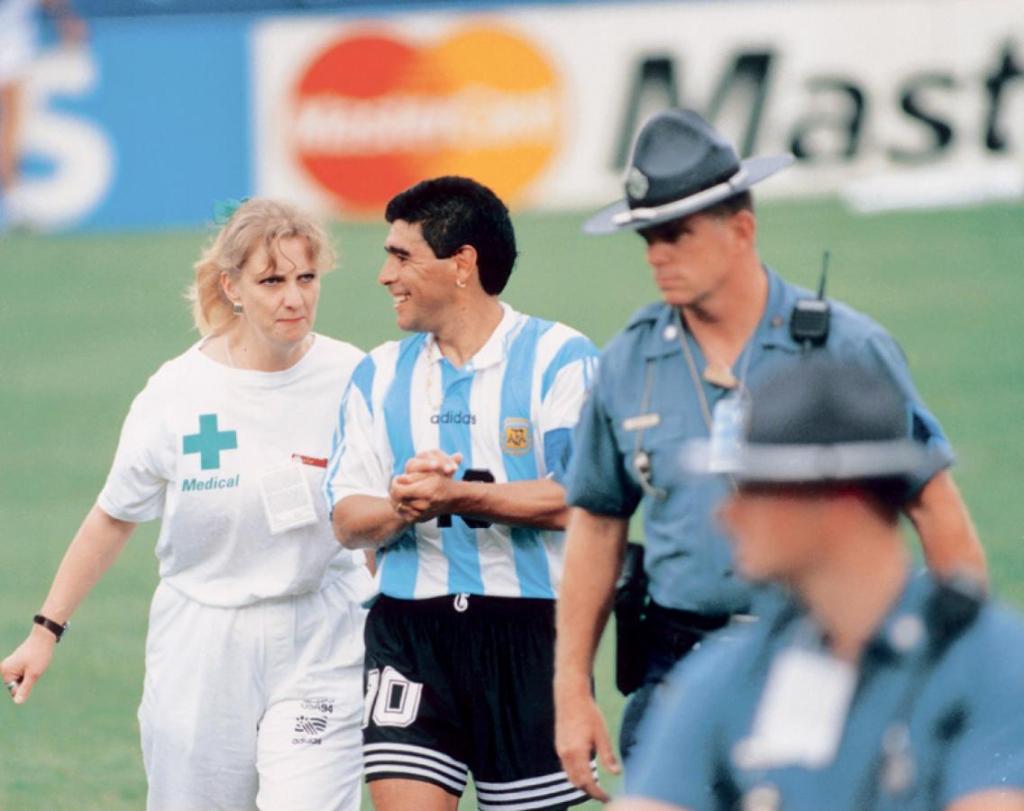
The following year, amidst the turmoil of his stagnant football career, a rare bright spot came when France Football awarded Maradona an honourary Ballon d’Or, normally awarded to the European Footballer of the Year, and a prize which, until then, could not be assigned to non–European players (France Football later published a revised list in 2016 to include players of all nationalities, which would’ve seen Maradona win the award in both 1986 and 1990). Maradona also returned to Boca Juniors in 1995, where he remained until his retirement 1997. One of his few highlights was when he made news headlines, in a sport rife with homophobia, for sharing a passionate celebratory “soul” kiss with Caniggia, after setting up his teammate’s goal in a 4–1 Superclásico derby victory over rivals River Plate in 1996. Diego’s final professional goal came from the penalty spot in a 2–1 home victory in a Torneo Apertura match for against his former club Newell‘s on 14 September 1997, while his final appearance came on 25 October 1997, in a 2–1 away win over Superclásico rivals River Plate, with Maradona being substituted by young star Juan Román Riquelme at half-time.
Life After Retirement
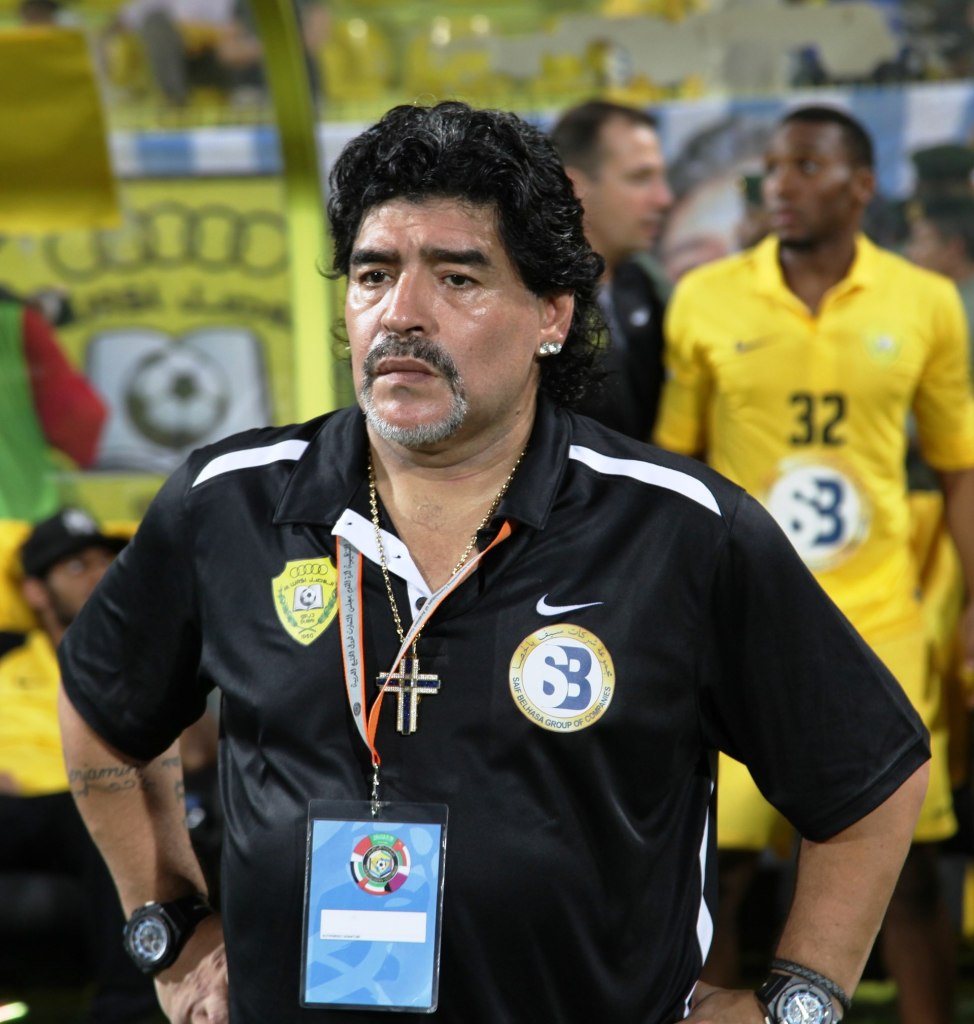
Following his retirement, Diego’s problems exacerbated. His worsening cocaine addiction, struggles with alcoholism, overeating, and his progressive weight gain led to numerous health difficulties, which persisted throughout the rest of his life; he was already hospitalised in 1999 and 2000 due to heart issues. Moreover, his increasingly problematic relationship with the media throughout his career escalated to the point that in 1998 he was sentenced for once firing a compressed air rifle at reporters outside his home in 1994, injuring four people. Moreover, as noted in an addition to the first part of this article series, I feel compelled to add that in 2021, approximately a year after Diego passed away, and after this article series was published, disturbing allegations made by a Cuban woman, Mavys Álvarez Rego, who first met the former Argentina captain in 2001, came to light; she accused Maradona of sex trafficking, forcing her into an abusive relationship, and raping her during this period, when, even more shockingly, she was still a minor. Additionally, Diego’s turbulent marriage to Claudia Villafañe finally ended in 2004, and he also experienced financial difficulties in retirement. One would have expected a player of his grandeur to be more connected to the game even after his playing career was over, but Diego’s attempts at pursuing a managerial career ultimately proved to be disappointing; he achieved underwhelming results with several clubs in Argentina, Mexico, and the UAE, while he instead suffered an ignominious quarter-final exit as head coach of the Argentina national side at the 2010 World Cup, following a heavy 4–0 defeat to Germany. In some ways, he became an almost tragicomical or even pathetic figure, a caricature of his former glorious self, with his occasional arrogance, use of illeisms, his blunt or overly grandiose statements, his brusque critiques of other players, and his constant almost infantile bickering with Pelé, the player with whom he is often thought to share the title of the greatest male footballer of all-time (with both players controversially winning the FIFA Player of the Century Award in 2000, which seemingly fuelled their rivalry), even being occasionally derided in the media.
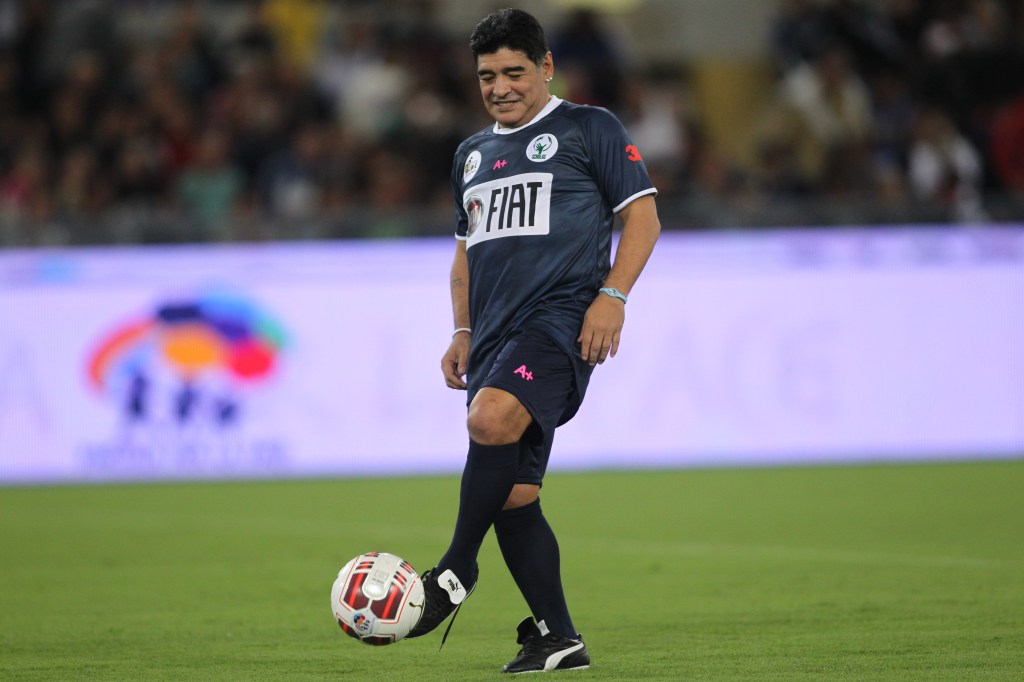
To the former Argentina and Napoli number ten’s credit, he did bounce back to an extent: for example, Maradona started hosting a talk show in Argentina: La Noche del Diez, a reference to his shirt number. Moreover, after already speaking out about wealth inequality and poverty during his time in Italy, even going so far as to criticise the Vatican for their inaction on this issue in a meeting with Pope John Paul II, which caused him to lose faith in the Catholic Church, he also became even more outspoken about politics following his retirement. Beyond his aforementioned close relationships with left-wing politicians such as Castro, Chávez, and Morales, examples of his political activism included denouncing George W. Bush, protesting against the U.S. invasion of Iraq, and condemning Israel’s military strikes on Gaza in 2014, while also voicing his support for Palestine. He also became more involved with world issues and charitable endeavours during this period, such as taking part in SoccerAid and the Match for Peace, as well as accepting a nomination as the Latin American director of the NGO Football for Unity. In 2015, his impact on Italian football and reputation as one of Serie A’s greatest players ever was also recognised, as he was inducted into the Serie A Hall of Fame. Unfortunately, however, controversy was still never too far away from Maradona; in 2014, for example, he was even accused of assaulting his girlfriend at the time, Rocio Oliva, which he denied, however, while his inebriated antics in the stands during Argentina’s final group game against Nigeria at the 2018 World Cup also drew negative attention in the press, and even led him to be hospitalised after he had collapsed.
Coincidentally, during this difficult period in Maradona’s life, Napoli also seemed to suffer without their talisman, who had won them their only league and major European titles to date during the club’s golden era. After years of gradual decline in terms of their performances and financial situation, the Neapolitan side were eventually relegated to Serie B in 1998, and were also unable to avoid relegation in 2001, after only just winning-back promotion to Serie A once again the prior season; to make matters even worse, the club even declared bankruptcy in 2004. Napoli did eventually manage to win promotion to Serie A again in 2006, and have since been on a gradual upward spiral, eventually winning the Coppa Italia in 2012, which was their first title since Diego had left the club in 1991. However, Napoli still have yet to capture their most coveted prize since Maradona’s aforementioned drug ban and departure from the Campanian side, namely another Serie A title; this arguably demonstrates above all how important his impact was on the club, and how he will forever be connected he with the history of the Partenopei (one of the club’s many nicknames; it stems from the siren Parthenope, from Ancient Greek mythology, whose body was reportedly washed ashore at the Bay of Naples, after she had cast herself into the sea and drowned when her enchanting songs failed to lure the hero Odysseus to her).
A Controversial Genius
When judging prominent figures such as Diego, especially following his tragic passing, it can be easy to excuse or even ignore his controversies out of respect for him and his family, and to remember him predominantly for who he was as a player. To do so would not be entirely correct, however; Maradona’s life is certainly somewhat of a cautionary tale for other young players, of the dangers that fame can bring. The moral of the fable that was his career thus serves as a reminder that talent is something sacred, which should not be squandered, but nurtured and shared with the world. While Diego should be admired for his ability, and while one should empathise with all of his personal difficulties and recognise his efforts to have a positive impact on society, one should also be equally cognisant of his mistakes, and not hold him up as an infallible paragon of virtue to be mimicked. Rather, one should encourage others to emulate his skills, but also be critical of his more vile actions, and learn what can be done to prevent other players, who have faced similar struggles, from falling into such predicaments. However, one wonders whether it was Diego’s shortcomings that also made him the player he was. After all, despite all of Messi’s goals and titles with Barcelona, and his remarkable consistency and more stable personal life, he is more introverted in character, and therefore does not have Maradona’s natural presence or leadership, and has thus yet to achieve what Diego did with Argentina at the World Cup (which still remains the most important competition in world football), a significant blot on an otherwise outstanding career. Diego’s flaws only make him seem more human to all of us in hindsight; they are what remind us that he was indeed merely a man, and they are humbling, as the make us reflect on our own defects. He embodied both the angelic in his gorgeous football and the demonic in his unsettled personal life. But notwithstanding all of his imperfections, his footballing ability, on the other hand, was truly not of this world. From hearing friends and family speak of him so enthusiastically, and by rewatching clips of him, it was clearly something pure and joyful, almost innocent and child-like in the eagerness, cunning, and flair he demonstrated with the ball at his feet, or in the way that he would toy with his opponents and leave spectators completely spellbound; to watch him was truly to observe poetry in motion. Without wanting to delve into the psyche of Maradona and make conjectures while attempting to analyse who he was, one can still surmise that given his circumstances, he was forced to grow up quickly (even though in many ways he never truly did), and that he expressed his inner child in his gameplay, and that football was even a form of escapism for him. There was nothing ostentatious or frivolous in the way he played; while highly skilful, he did not have the exuberant and contrived style of a player such as Cristiano Ronaldo. Maradona’s moves were often unexpected, but always served a distinct purpose, and as a result, he often gave the impression of playing purely by instinct, which is what made his skills so astonishing. He did not just play football, he redefined it by pushing new boundaries, showing us what could be done with a ball, and by making the impossible seem possible. He taught even the most underprivileged of us how to dream, and he instilled his passion for the game in all of us. For him the ball was not merely a utensil, but essentially an extension of his soul.
“I have erred and I have always paid [for my mistakes], but the ball cannot be stained.”
Diego Maradona
Although this term is often thrown around excessively, rendering it almost devoid of its original meaning, it goes without saying that Diego truly was a genius on the pitch; he saw spaces that no-one else did, potential plays before anyone else, and with each calculated pass and movement he almost resembled a chess master. His artistry was also remarkable; he conjured unpredictable and magical plays out of almost nothing with his wand of a left foot, and carved his way through defences effortlessly, each subtle movement and deft touch was a deliberate brushstroke on a canvas of green grass, which gradually built up to create something truly magnificent. When faced with Maradona’s grace, footwork, and elegance, it almost seemed like he was not playing football at all, but rather that he was dancing across the pitch. Without wanting to resort to national stereotypes and Argentina’s association with tango (coincidentally, one of Maradona’s trademark moves was the rabona cross, from which the tango step it resembles has derived its name), it is known for a fact that Diego was also a good dancer, and that he enjoyed going dancing at clubs in his free time (maybe even too much), and later even competed on the Argentine edition of Strictly Come Dancing. He brought this unique flair to his astonishing gameplay, which almost had a clear cut tempo to it, with defined musical rhythms: each burst of acceleration an accent, each stroke of the ball a melodic gesture, each calculated move a crescendo marking in a phrase building to a symphonic climax that would almost inevitably resolve with a goal. When set to music, his individual goals almost come across as having been choreographed. From the way he played, it is undeniable how much he loved the game, and how much enjoyment he got from entertaining the crowd; football was not just a profession for him, but life. He never stopped seeing it as a fun game at heart; taking all of that away from him ultimately led to his slow demise. His suspension for using banned substances was not merely a punishment in that sense…for him it was a death sentence.
A Final Farewell
Maradona passed away in Buenos Aires from a heart attack on 25 November 2020; he had been ill for some time, and had already undergone surgery for a subdural hematoma earlier that month. Although he was barely 60 at the time of his death, it almost seems incredible that he even lived this long after everything he went through, his rehabilitation, the gastric bypass surgeries he underwent in attempts to lose weight (which were often cruelly mocked and unfairly shamed by the public), and all of his personal battles and countless struggles with his health that he faced, even cheating death several times before. When he left Napoli, he was the club’s all-time leading goalscorer, with 115 goals, and ever since, Napoli have failed to win another Serie A or European title (up until this article was written, at least); although his club goalscoring record has since been overtaken by Marek Hamšík and Dries Mertens, there is no doubting that he is generally regarded as the greatest player ever to have donned the Napoli shirt. In Napoli’s first match following Diego’s death, the club’s players payed tribute to him by touchingly all donning the number ten shirt that Diego wore, and which was retired once he hung up his boots, in 2000. The club’s current president Aurelio De Laurentiis is reportedly even hoping to acquire the San Paolo stadium from the city of Naples and rename it after Maradona. Across Italy and the entire globe, there have been numerous tributes to him and obituaries written in his honour; in Serie A, the following weekend, a minute of silence was observed before each match, and an image of Diego was projected on stadium screens in the tenth minute of play. Compatriot Lionel Messi dedicated his goal in Barcelona’s 4–0 home win over Osasuna to Maradona by revealing a Newell’s Old Boys shirt worn by the latter under his own jersey, and subsequently pointing to the sky. The Argentine President Alberto Fernández announced three days of national mourning, such was his influence on his country. Indeed, since Maradona’s masterpiece in 1986, Argentina have yet to win another World Cup title; despite producing a plethora of talented players in the number ten role, whom have each been given the “New Maradona” monicker, with the most famous being Messi, none of them have been able to replicate what Maradona achieved for his country (yet, at least).
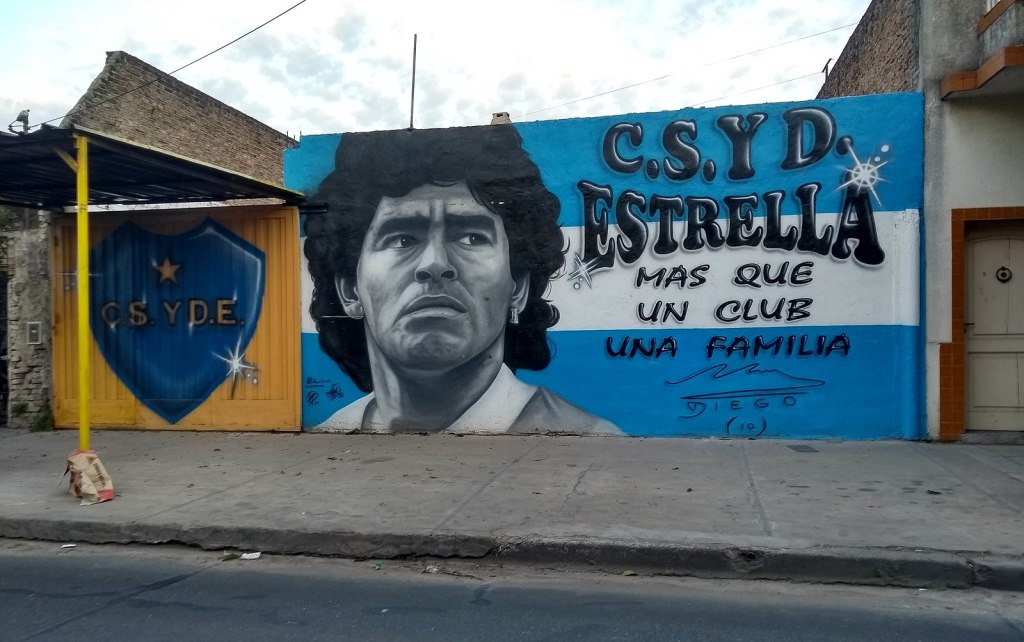
I hope that now he can finally put his demons to rest at least and be at peace. Regardless of how one feels about Maradona personally, and his many character flaws, his departure from this earth was undoubtedly a sad day for football, considering everything he gave to and did for the sport, and the sporting world still mourns him. However, he will never be forgotten, and what he achieved on the pitch has rendered him truly immortal. His legendary spirit will always live on in every child’s dreams to pursue football, in every person who kicks a ball about in the street with their friends, in every stadium, in every piece of brilliant individual skill, and in every goal.
 Mad About Football
What a fantastic set of four essays on Diego.. loved them, thanks! So well written, balanced and meaningful, but also not “on the fence” overall. The closing paragraph is superb. GRACIAS!!
LikeLike