
Messi’s numerous titles and awards throughout his career – k4_creatives/Shutterstock.com
Football is a beautiful, albeit immensely flawed game. However, like life, it can be particularly cruel and unfair at times. Rarely do we ever see the fairytale endings we desire for our sporting heroes. Gianluigi Buffon having the opportunity to win the UEFA Champion’s League finally in 2017, at the ripe old age of 39, having endured two prior final defeats, and a relegation with Juventus following the 2006 “Calciopoli” scandal, always comes to mind for me personally. But the goalkeeper could do nothing but watch as Juventus were demolished after half time by a legendary Real Madrid side that became the first club ever to defend the title in the post-1992 Champion’s League era. Another infamously disappointing moment was when Liverpool legend Steven Gerrard mis-controlled Mamadou Sakho’s pass in a Premier League match against Chelsea at Anfield, conceding possession to opposing striker Demba Ba, before slipping and allowing the forward to run through on goal and score; the match ended in a 2–0 defeat, and was a huge blow to Liverpool’s morale with only two matches remaining. Manchester City eventually claimed the 2013–14 title by winning their remaining games and finishing two points above the Reds, preventing them from claiming their first league title in the Premier League era. Sadly, Gerrard would ultimately retire from professional football without ever winning the Premier League. Former Italy number ten Roberto Baggio is another icon who evokes painful memories for many Italians such as myself, a remarkably talented player who had always dreamed of defeating rivals Brazil in a World Cup final; but when the opportunity came in 1994, despite carrying a struggling Italy through the knockout stages with some beautiful and decisive last-minute goals after a difficult start to the tournament, hampered by injury, he missed the final penalty in the shoot-out, putting the ball over the cross-bar, and he has since been immortalised in an iconic photograph, capturing his despondent pose, with his head bowed down in defeat and his hands on his hips, while Brazil goalkeeper Cláudio Taffarel instead fell to his knees ecstatically in celebration as his nation claimed their fourth World Cup crown. And similarly, Baggio’s international team-mate in that tournament, the eternally brilliant defender Paolo Maldini, who along with the recently recovered legendary captain Franco Baresi (the latter of whom, like Baggio, unfortunately also missed his penalty in the shoot-out) helped prevent Brazil’s stellar attacking duo of Romário and Bebeto from scoring in the final, also sadly never collected a winner’s medal with Italy; despite winning everything at club level with Milan, and suffering two heartbreaking final defeats in major international tournaments with Italy (the other coming from a golden goal in extra-time at Euro 2000 against France), as well as two semi-final eliminations (Euro 1988 and the 1990 World Cup), and notwithstanding the fact that he still had an incredible international career overall, he was never able to claim the most prestigious team prize in world football.
However, every so often, we do get football stories that are so incredible, that they almost seem to have been scripted or written in the stars. Ronaldo coming back from a series of seemingly career ending injuries to win the 2002 World Cup with two goals in the final against Germany, after being on the losing side four years earlier against France, is one example, as is Leicester City’s incredible and unlikely first ever Premier League title victory in 2015–16. However, this can also apply to other sports as well, such as Sidney Crosby scoring the golden goal for Canada in the gold medal match against the USA at the 2010 Winter Olympics in Vancouver, Jesse Owens dominating the Berlin 1936 Olympics under Adolf Hitler’s nose in Nazi Germany with four gold medals across various athletic disciplines, or Muhammad Ali completely reinventing his boxing style following his exile, and eventually reclaiming the title of World Heavyweight Champion in 1974 against George Foreman.
Sunday 18th December 2022 was one of those moments. I can proudly say that I witnessed sporting history in the making, along with some of my friends, as we watched the great Lionel Messi, at the age of 35, seemingly in the twilight of his career, overcome his past demons, and capture the one title that had seemingly evaded him for his entire career, the pinnacle of world football, that title which separates the great players from the truly legendary ones, the FIFA World Cup. In this article, the first in a four-part series on Messi’s memorable performances throughout the 2022 World Cup, I will examine Messi’s path to winning the title, exploring all the events that made it such a beautiful and iconic event, including the captivating final victory against France.
Not only was this a wonderful moment, as one of numerous neutral football fans, to see a player as incredible and as likeable as Messi finally complete a deserving historic achievement, but the match itself had everything a football fan could possibly want in such a monumental game between two great sides led by several stars. Finals are normally rather dull affairs, but this one, undoubtedly the best World Cup final I’ve ever seen in my life-time, had it all: goals (not just many, but some great ones, too), great football and team-play, drama, late come-backs, extra-time, penalties… Even with all the controversy surrounding the 2022 World Cup in Qatar, my native Italy shockingly failing to qualify for the final tournament, and Canada (the country in which I currently reside) going out in the first round, I couldn’t help but be happy to support an incredible player such as Messi as he finally succeeded in achieving his lifelong dream of winning the most important title in world football with Argentina. As someone who grew up watching the likes of Roberto Baggio, Alessandro Del Piero, Zinedine Zidane, Roberto Mancini, Manuel Rui Costa, and Francesco Totti in Serie A, I always had an affinity for number tens, technical, creative playmakers, who could also score some brilliant goals, and who often operated between the attacking and midfield lines. Although this role is somewhat obsolete in contemporary football, as current formations have forced these players into other positions, Messi is certainly the archetype for the modern number ten. Moreover, given Argentina’s and Messi’s ties to Italy, and the fact that my father’s hometown club, Napoli, which my family all support (along with Juventus), has an historic association with Messi’s legendary compatriot Diego Maradona, Argentina were often one of the teams I followed in World Cups whenever Italy were eliminated.
It wasn’t just the fact that Messi had finally won the biggest title in the men’s game that made this moment so historic, but also his performance throughout the competition, and in the final itself (scoring twice, and again in the shoot-out, and even being named player-of-the-match), which has fully cemented his legacy and immortalised him in the pantheon of football legend as arguably the greatest male footballer of all time. With the likes of Pelé, Diego Maradona, Cristiano Ronaldo, Ronaldo, Zinedine Zidane, Johan Cruyff, Michel Platini, Alfredo Di Stefano, Ferenc Puskás, and arguably even Marco Van Basten, Giuseppe Meazza, George Best, Franz Beckenabeur, Stanley Matthews, Garrincha, Romário, Zico, Eusébio, and Ronaldinho, among others, also competing for the title of the best male footballer of all time, it must be said that many of them did not quite achieve absolutely everything possible, which has often made it difficult to choose an undisputed “GOAT” (Greatest of All-Time) among male footballers; as such, the debate has ultimately become somewhat subjective, with fans often preferring players of their own nationality or who played for their club, and of course there’s also the “eye test” argument, which is quite personal as well. Cristiano Ronaldo, Cruyff, Platini, Di Stefano, and Puskás never won a World Cup; Maradona and Ronaldo never won the European Cup or its successor, the Champion’s League; Pelé, despite the strength of the Brazilian League at the time and his success against European clubs in the Intercontinental Cup and national sides at the World Cup (as well as against other top South American sides in the Copa Libertadores), never played professionally in Europe, which is often held against him, somewhat unfairly I might add, and therefore never won the European Cup or a major European league title. Zidane won almost all possible major titles for which he was eligible, but was not as prolific, precocious, or as consistently successful, despite his almost unparalleled technical skill and ability at his peak. Best and Van Basten were brilliant, successful, and prolific, but unfortunately excess and injuries respectively limited their time at the highest level, and brought their careers to an early end. But Messi, on top of his natural talent, skill, and ability, precociousness, consistency, and even longevity as a footballer, and all his goals, assists, records, and individual awards, can now also claim to have won everything possible for club and country (and individually), which seemingly puts him into a category of his own, in my humble opinion, even if others still might understandably disagree. After all, what makes these debates so interesting is that it’s not always so clear cut, and there are many valid arguments.
A Long and Difficult Path to the Top
It must be said, however, that what also makes this World Cup title so significant is that throughout Messi’s career, much like his perceived career rival Cristiano Ronaldo, although he was talented, highly successful and prolific at club level, his international career was not always so positive, with numerous disappointments at senior level, before finally winning some silverware for his country at senior level (initially only winning a gold medal at the 2008 Olympics with the under-23 side, and the 2005 under-20 World Cup at international level). These shortcomings included three consecutive final defeats in major tournaments between 2014 and 2016 (in particular the 2014 World Cup final loss to Germany), which earned him plenty of criticism from pundits and the Argentina fans in particular (I will touch upon this in my second article series on Messi), and even forced him into a very brief international retirement in 2016. Understandably, however, Cristiano Ronaldo’s sometimes mixed or even underwhelming international performances were often somewhat forgiven seeing as he seemingly had a weaker national side on paper for much of his prime, after the end of the so-called Portuguese “golden generation in 2006.” Criticism of Messi’s more negative performances for his country was naturally more callous on the other hand, as he was instead surrounded by a plethora of Argentine attacking talent in major tournaments during his prime years. Admittedly, however, in his defence, beyond the impressive attacking depth that Argentina boasted, Messi was expected to lead several otherwise unbalanced sides, which in hindsight was certainly a more difficult task than it might have seemed. However, as was the case for Cristiano Ronaldo following his Euro 2016 victory with Portugal, winning the 2021 Copa América title with Argentina changed things drastically for Messi: not only did the international title solidify his claim as the greatest player of his generation, and arguably the best ever, but his international performances improved significantly, and he also began to be appreciated more back at home. Ironically, however, in contrast to the past, it was his club performances which instead seemed less impressive following the South American Championship victory.
In the summer of 2021, Messi made a shocking and much-publicised free transfer to Paris Saint-Germain (PSG), signing a lucrative deal with the French side, after over 20 years at Barcelona between the first team and the youth system; the move came about soon after news broke that the Catalan side had been unable to renew his contract due to their controversial financial struggles, despite an agreement of terms being reached between the club and the player. Admittedly, there had been tensions between the two parties the previous summer, which led to Messi putting forth a transfer request, after being linked with Pep Guardiola’s (his former manager) Manchester City, which was blocked, however. Nevertheless, the club’s relationship with Messi had improved again throughout the 2021–22 season, and both parties seemed to have agreed upon terms. Messi was actually one of several star players to join the wealthy Parisian club in the 2021 summer transfer window, some of whom were also surprisingly signed on free transfers, in order to boost the club’s Champion’s League hopes, after years of domestic dominance. It seemed that the peak of Messi’s career was finally coming to an end at the age of 34 when he joined PSG, in part due to the fact that widespread public perception of Ligue 1 sees it as being less competitive and weaker than other top five European leagues, despite PSG’s wealth and indubitable quality. Indeed, Messi’s club performances and goalscoring record also seemed to have declined slightly during the first part of the 2021–22 season; moreover, although the team had plenty of offensive firepower (with the mouthwatering and potentially lethal attacking trio of Messi, Neymar, and Mbappé, or the ‘MNMs’), it also lacked balance, and the Argentine surprisingly initially seemed to struggle to gel with his former Barcelona teammate Neymar of Brazil, his international teammate Di María, and young French star Mbappé up-front, adopting a more creative role under manager Mauricio Pochettino. Donning the dark blue attire of PSG, and now wearing the number 30 on his back, his first ever shirt number (allowing his friend Neymar to retain the number ten), he almost looked out of place in the French capital. However, following the 2021 Copa América victory over hosts and rivals Brazil (in which he finished as the top scorer and assist-provider with 4 goals 5 assists respectively, and ultimately won the Golden Ball Award, along with Neymar), his performances and goalscoring record for Argentina, on the other hand, improved significantly: he finished the 2021 calendar year with nine goals in 16 appearances (all of which came in competitive fixtures – the most he had managed in a single year since 2012), also overtaking Brazilian legend Pelé as the highest–scoring South American international male footballer of all time, following his hat-trick in a 3–0 home win over Bolivia in a 2022 World Cup qualifier in September. Argentina sealed a place at the tournament with five matches to spare following a 0–0 home draw against rivals Brazil in November, who finished first in the group, while La Albiceleste (‘The White and Sky Blue’, the Argentina football team’s nickname, referencing the colours of their kit and flag) eventually finished in second place with 11 wins, six draws, and no defeats.
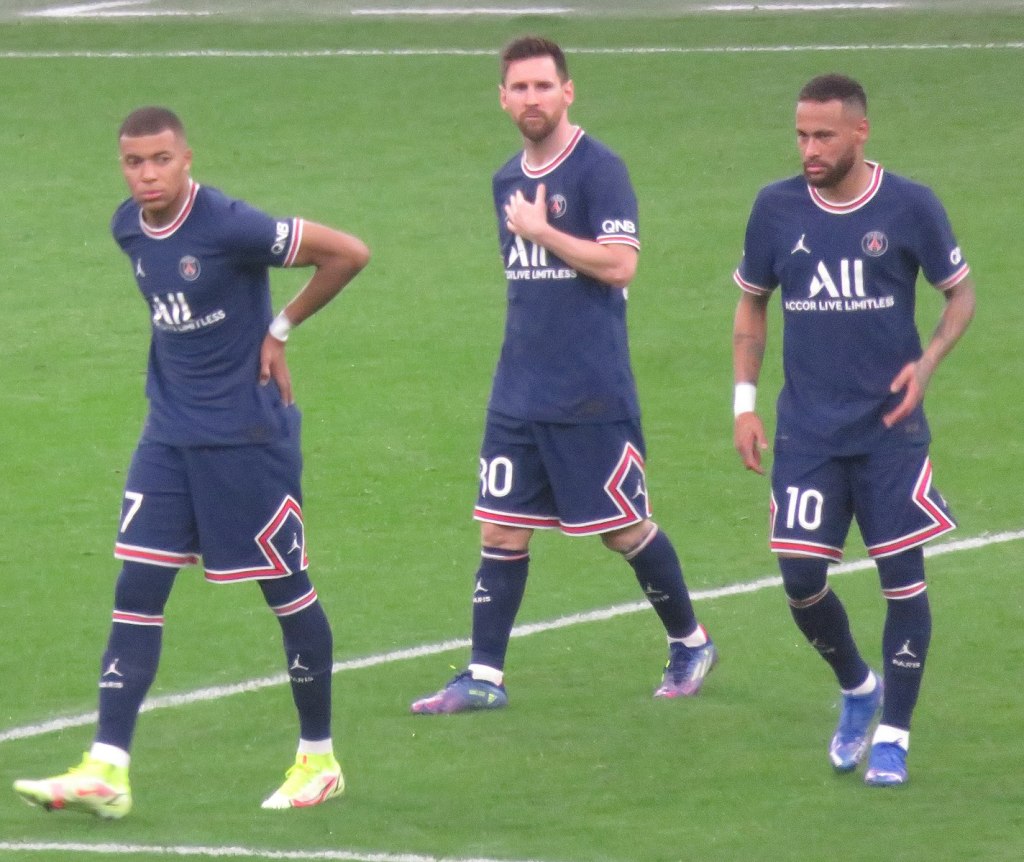
Despite the criticism Messi and PSG endured for an early Champion’s League exit to eventual winners Real Madrid in the round of 16 after an extraordinary second-leg comeback, the 2022 calendar year was largely more positive statistically for Messi at club level; despite only scoring a meagre six times in the league (the first time since the 2005–06 La Liga season, when he was still just a precocious teenager, that he failed to reach double figures), he provided an impressive 14 assists, and also had the satisfaction of scoring a decisive goal from outside the box in a 1–1 home draw against Lens, which crowned PSG as Ligue 1 champions. At international level, he continued to shine, and was also brilliant in a more creative role as Argentina won the 2022 UEFA-CONMEBOL Finalissima at Wembley, producing a dominant player–of–the match performance and recording two assists in a 3–0 win against Euro 2020–21 winners Italy; the match was a rebranding of the former Artemio Franchi trophy, which Argentina had last won in 1993, and which seemingly replaced the now defunct FIFA Confederations Cup, giving Messi his second title with Argentina. Messi’s first assist came after he turned and danced past full-back Giovanni Di Lorenzo on the left from just outside the area, holding him off before putting a low cross into the box for Lautaro Martínez to open the scoring with a relatively simple finish. After Angel Di María had already doubled Argentina’s lead just before half-time, Messi’s second assist came in injury time of the second half; following an individual run from midfield on the counter-attack, he laid the ball off for Paulo Dybala, after a fortunate ricochet following Di Lorenzo’s challenge, who finished well from just inside the box to make the score 3–0.
2022 World Cup Group Stage and Round of 16
In the lead-up to the 2022 World Cup, Messi had started the 2022–23 season strongly with PSG, and had already scored 11 goals for Argentina in only seven appearances (one in a 3–0 win over Venezuela in qualifying, with Argentina finishing second in their group, and the other ten in friendlies). He seemed to be playing in a far more liberated manner and clearly had something more to prove to himself as well as his detractors. As the reigning South American champions, and coming off a 36–match unbeaten streak (just one match shy of Italy’s international record from the previous year), Argentina were one of the favourites in the lead-up to the World Cup, and an EA Sports FIFA simulator, which had correctly predicted the last three World Cup winners, had even elected Argentina as the tournament winner. Would this finally be Messi’s moment? To add to the excitement, it was noted in the media that the World Cup draw allowed for a potential dream final match-up between Portugal and Argentina, which would see generational rivals Messi and Cristiano Ronaldo face off against one another in a final showdown for the World Cup title, and possibly even for the title of the greatest player ever. Only two weeks prior to the tournament, however, Messi suffered an injury scare, although he later reported that he felt “good” to the relief of many of his fans, especially Argentines!
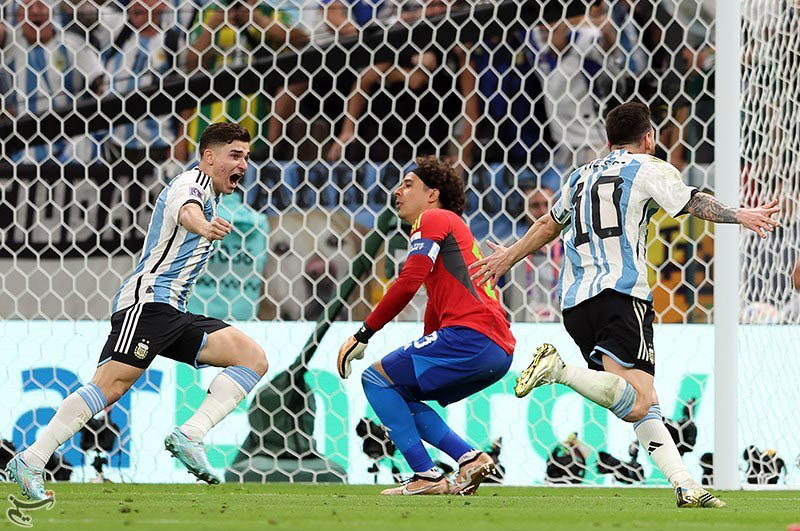
In contrast to past tournaments, where Messi was criticised in Argentina for not singing the Argentine national anthem before games, he was now visibly belting it out along with his teammates and seemed to be far more outgoing, and was clearly a part of the group, while the Argentine fans also finally seemed to have accepted him; he even remarked that both he and his teammates were playing in a far “calmer” manner than in the past. He once again appeared to be in form and playing with new-found freedom and enjoyment as he netted a first-half penalty in the opening match against Saudi Arabia, which was awarded after a controversial decision, with Messi placing the ball low and calmly to his left, while the keeper went the other way; he also had another goal disallowed for offside, with Argentina also seeing two more disallowed, one of which appeared to be legitimate. However, following an Arabian counter-attack in the opening minutes of the second half, a somewhat fortuitous deflection by Cristian Romero on a well-worked shot by Saleh Alshehri tied the match. To add to the drama, after only a matter of minutes, a stunning curling effort by Salem Aldawsari from just inside the box, after a nice bit of skill, gave the Saudis a 2–1 lead, which Argentina were unable to overturn, leading to a shocking upset. This seemed to be Argentina’s “simplest” match on paper, but the Saudis certainly had plenty of support from the home crowd; the tournament certainly didn’t start off as planned for the Argentines, and it seemed that another disappointment was in the cards for them, and for Messi in particular. Nevertheless, Messi, manager Lionel Scaloni, and the rest of the squad seemed confident in their unity and ability to bounce back with the support of the fans behind them, with Messi imploring the supporters to “have faith.” In the team’s second group match against Mexico, despite Argentina looking nervous in the opening minutes, with Messi initially struggling to have an impact, he was later involved in both goals of the match in the second half, to help his nation to their first win of the tournament. For the opener, he carried the ball and laid it off to Enzo Fernández just inside the opposing half, continuing his run forward; Fernández then played a pass out wide to Di María on the right. Messi found space just outside the box in the middle, allowing the winger to pick him out, and then scored with a beautiful long–range shot. The Argentine number ten then also recorded a rather generous assist when he passed the ball to Fernández from a corner kick on the left, who subsequently scored with a lovely curling effort, which was later nominated for the Goal of the Tournament award (which was ultimately won by Brazil’s Richarlison for his stunning second goal – an acrobatic volley – in a group match against Serbia); as a result, Messi became the first player to assist in five consecutive World Cups, and was even named player-of-the-match. Although in the final group match against Poland, Messi had a dubious penalty saved by the brilliant Wojciech Szczęsny in goal, and was not directly involved in either of his team’s goals (scored by Alexis Mac Allister and Julián Álvarez in the second half), he still produced arguably his best performance of the group stage as Argentina prevailed 2–0 once again and topped their group, following their early scare of potentially not qualifying for the second round. A crisis had been averted largely thanks to Messi.

In the round of 16 match against Australia, Messi made his landmark 1,000th career appearance, and marked the occasion by finally netting his first ever World Cup knock-out round goal, to open the scoring in an eventual 2–1 win, earning his second player-of-the-match award of the tournament. Following a free-kick of his on the right that was cleared away, Messi then finished off a lovely team move after cutting inside with a wonderful, precisely placed, low curling effort into the far bottom corner, following a splendid bit of link-up play involving himself, Mac Allister, and Nicolás Otamendi. After a first-half with few genuine chances at either end, Argentina’s efforts to push forward were rewarded just over ten minutes into the second half, when Álvarez doubled the Argentines’ lead: Rodrigo De Paul and Álvarez capitalised on an Australian defensive error, putting pressure on goalkeeper Matthew Ryan following a back-pass by defender Kye Rowles; Álvarez subsequently dispossessed the shot-stopper and scored. Argentina seemed to be in control, with Messi even pulling back the years to embark on an extraordinary solo run past several players in the 64th minute, after receiving the ball just inside his half, which culminated in an Argentine corner kick. However, with less than 15 minutes remaining, a somewhat fortuitous own goal by the hapless Fernández, who deflected Craig Goodwin’s powerful long range effort past his own keeper with his head, gave the Socceroos some hope. To add to the drama, Australia even came close to equalising on a few occasions towards the end of the match, in particular with full-back Aziz Behich, after a brilliant ‘Messi-like’ individual run into the box, although his shot was heroically blocked by the sliding challenge of centre-back Lisandro Martínez. Notwithstanding the escalating pressure from the Australians, wth only two minutes of regulation time left on the clock, Argentina almost put the result beyond any doubt when a trademark Messi dribbling run on the counter-attack saw him set-up Lautáro Martínez inside the box with only the keeper to beat; however, the striker shockingly put his shot over the bar. In injury time, Messi also had two promising opportunities to put the tie to bed himself: the first just missed the target, after yet another fantastic mazing run, while the second arose after a chance he had created for Lautáro Martínez had been saved by Ryan in goal, with Messi mishitting his difficult first-time rebound shot wide of the right post. Incredibly, Australia then almost tied the match with a last-ditch one–on–one effort by substitute by Garang Kuol, after Messi had lost possession in his own half; the young Australian forward did well to control a cross and turn past his marker inside the box, although his low shot at the near post was saved superbly by Emiliano Martínez in goal, who positioned himself well to cover the goalmouth. Despite the Australians’ resolve, Argentina had shown grit and determination, in addition to their quality, and had managed to hang on for the win and advance to the next round, even though it had not been their most convincing performance.
For a team like La Selección, who had a rich and successful footballing history, who were captained by the best player of his generation, and who were regarded as potential title contenders, reaching the last eight was the bare minimum that would be accepted by the public (the same also applied to Messi); but even so, after the Argentine team’s success in the past few years, and their continued World Cup–title drought, a quarter-final elimination would still be a disappointing result. And awaiting them were a tough opponent and a rival team, their most intimidating adversary yet: the Netherlands.
If you enjoyed this article, feel free to read the second part of this article series on Messi at the 2022 World Cup, which recounts the epic quarter-final encounter against the Netherlands!
 Mad About Football